
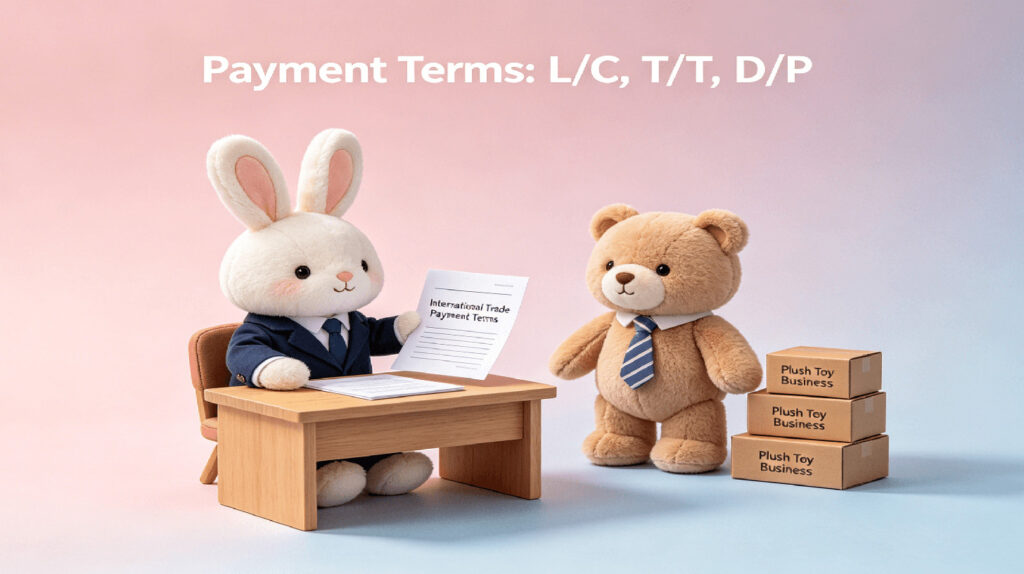
In international trade, payment terms are not just a financial method. They are a risk-sharing system between buyer and supplier.
In the plush toy industry, common payment methods include:
- T/T (Telegraphic Transfer)
- L/C (Letter of Credit)
- D/P and D/A
- OA (Open Account / Credit Terms)
Each method reflects a different level of trust and risk control.
In this article, we share how we view payment terms from both a buyer’s and supplier’s perspective.
1. T/T Payment: The Most Common and Balanced Method
The most widely used payment method is:
👉 30% deposit + 70% balance against copy of B/L
This is especially common for what we call regular orders, usually under USD 100,000.
Why 30% Deposit?
In practice, 30% is not random. It is a balance point.
For suppliers:
- Material purchase starts early
- Labor and sampling cost are high
- Cash flow risk exists before shipment
For example, on a USD 50,000 order:
- Around USD 15,000–20,000 may be spent before production even finishes
If deposit is too low (like 10–20%), the risk is too high for the factory.
If deposit is too high (40–50%), the buyer carries too much risk:
- Supplier risk (quality / delay / default)
- Trust risk
- Cash flow pressure
👉 30% is a practical balance point built from real business experience.
2. Large Orders Require Flexible Payment Structures
For big orders, a fixed payment model does not work well.
Instead, payment should match production progress and risk control.
We once handled a USD 4.1 million order from Turkey.
Instead of standard T/T, we designed a staged payment plan:
- 5% deposit to start raw material preparation
- 10% after material inspection by third party
- 10% after 1/3 production completed + inspection
- 10% after 80% production + second inspection
- 15% after final inspection before shipment
- 50% after shipment against B/L copy
This structure allowed:
- Risk to be shared step by step
- Buyer to monitor production
- Supplier to secure cash flow gradually
The result was a successful long-term project without using L/C.
3. Small Orders Are About Trust, Not Strict Rules
For small trial orders, payment terms are more flexible.
Why?
Because small orders are not about profit.
They are about:
- testing cooperation
- showing production quality
- building long-term trust
A few hundred dollars order may not matter in profit, but it can decide whether a customer places:
- future regular orders
- or even large orders
So in many cases, we focus more on:
👉 speed
👉 communication
👉 service quality
4. Credit Terms (OA / 30–90 Days): Opportunity and Risk
Some long-term customers or large retailers may request credit terms such as:
- 30 days
- 60 days
- 90 days
Credit terms can help buyers improve cash flow and expand business faster.
But they also increase risk significantly for suppliers.
A Real Case We Experienced
We once offered credit terms to a long-term importer.
Within less than two years, the customer went bankrupt.
Later we learned:
- The buyer had credit terms from multiple suppliers
- Cash flow became “too flexible”
- They expanded aggressively and invested in risky areas
- Eventually failed and left unpaid debts
👉 This also shows that credit terms can unintentionally increase business risk.
5. How We View Credit Terms Today
Large retailers and supermarket chains often request payment terms.
But we carefully check:
- Is the credit backed by the buyer directly, or a trading company?
- Is there strong financial background or third-party guarantee?
- What is the actual risk exposure?
Even for large buyers, risk structures are not the same.
Our Principle
As a plush toy manufacturer, our general policy is:
👉 We do not offer open credit terms (OA) as standard practice.
Instead, we prefer:
- Clear T/T payment structure
- Flexible inspection during production
- Full transparency in production process
This allows:
- Buyers to feel secure
- Suppliers to maintain stable production
- Long-term cooperation to be sustainable
Conclusion
Payment terms in international trade are not just payment methods.
They are a risk control system between two businesses.
- T/T is the most balanced model
- Large orders require structured payment plans
- Small orders are about trust building
- Credit terms must be carefully evaluated
In real business, the goal is not just to complete a transaction.
It is to make cooperation sustainable and safe for both sides.
