
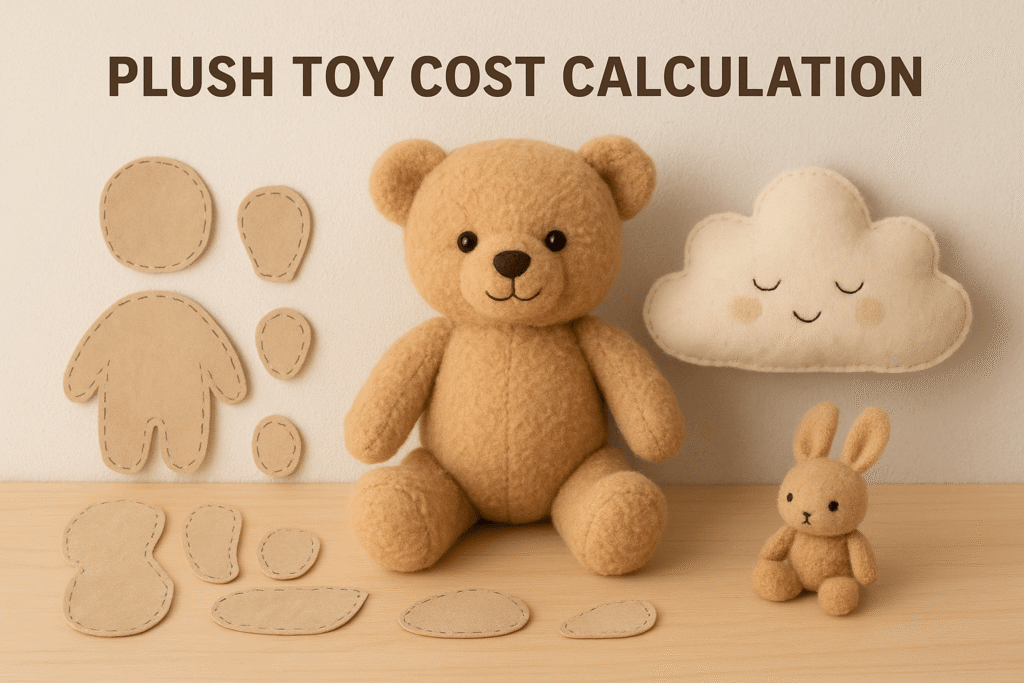
Cost calculation is the foundation of every successful plush toy order. A product that looks adorable may fail in the market if the cost is not accurate. In the last few years, the way we estimate costs has changed a lot. We used to rely on experience, manual layout and handwritten tables. Today, we combine 3D scanning, digital pattern layout, and time measurement to get accurate cost numbers with higher efficiency.
This article explains how we do it, step by step.
1. The Old Way: Manual Pattern Layout and Experience
For a long time, cost estimation was mainly based on experience:
- A designer cut paper patterns by hand
- Layout was done manually on fabric
- Waste ratio was estimated by experience
- Time cost was estimated roughly
When we had a physical sample, we used tools like rulers and scissors to measure and calculate fabric usage. It worked — but it was slow, highly dependent on the designer, and often resulted in different answers from different people.
If the sample was complex, the final cost sometimes changed after production. This created risk for both factory and customer.
2. The New Way: 3D Scanning, Modeling and Digital Layout
Now we add a digital layer on top of the traditional process.
When we receive a sample or a prototype, we scan it using a 3D scanner and import the model into software such as:
- Clo3D
- AutoCAD
- Rhino
- SolidWorks
- Specialized nesting software
The software does three important things:
- Build 3D model of the toy
- Flatten the model into 2D fabric patterns
- Automatically calculate material usage and waste ratio
This gives us three direct advantages:
- Accurate fabric consumption
- Optimized layout reduces waste
- Instant modification when size changes
However, because plush toys often have irregular shapes and highly varied sewing techniques, we have to admit that manual pattern making by experienced designers is still the primary method, and digital tools mainly play an assisting role..
3. Material and Accessory Cost Filling
Once the fabric usage is clear, we fill in the material costs:
- Plush fabric
- Short pile fabric
- Crystal velvet
- Polyester stuffing
- Eye, nose, embroidery, zipper, Velcro, etc.
Each item has its unit price:
- Fabric price per meter
- Stuffing price per kg
- Label price per piece
We enter these into a cost sheet. The sheet calculates automatically:
Total cost of materials = (usage × unit price)
This part is very direct and transparent. There is no guesswork.
4. Measuring Production Time by Making the Toy
We also measure time cost.
Instead of estimating, we build the toy by hand.
The designer or sewing worker makes one prototype:
- Cutting time
- Sewing time
- Turning and stuffing time
- Decoration time
- Final finishing
We record every step using a timer.
For example:
| Step | Time |
|---|---|
| Sewing arms | 6 minutes |
| Stuffing | 4 minutes |
| Final closure | 4 minutes |
| Total | 14 minutes |
This gives us a real production time, not a guess. We then multiply by labor cost per minute.
5. Adding Management, Operation and Profit
Direct cost is not final cost.
We still need to add:
- Management cost
- Factory overhead
- Quality inspection
- Electricity & rent
- Packaging
- Export expenses
- Profit
We usually use a ratio, for example:
Overhead + margin = 8% – 15% of total cost
When all numbers are added together, we get the final cost price.
This method is clear, repeatable and logical.
Conclusion
The core of toy cost estimation has not changed: we need to know material consumption, time, and overhead.
What changed is the workflow.
- Before: manual experience, handwriting, slow and inconsistent.
- Now: 3D digital modeling, automatic layout, accurate data.
This gives us:
- Faster quotation
- Clearer communication with customers
- Lower production risk
- Better control of profit
For factories and buyers, this is not just technology. It is a business advantage.
When cost is accurate, orders move faster, and cooperation becomes smoother.
