
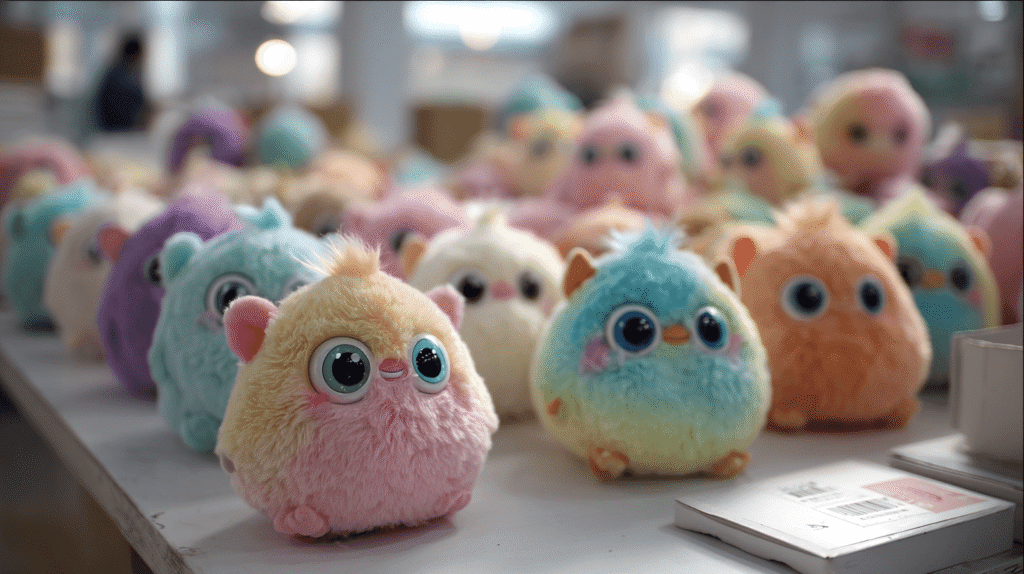
Accurate cost calculation is the foundation of every successful plush toy order. A toy may look adorable, but if the cost is off, it can lead to lost profit, production delays, or even order cancellations.
In the past, we relied heavily on experience, manual layouts, and handwritten tables. Today, we combine 3D scanning, digital pattern layout, and precise time measurement to calculate costs faster, more accurately, and consistently.
This article explains our process step by step, showing how modern workflows reduce risk and improve efficiency for both factories and buyers.
1. Traditional Cost Estimation: Manual Patterns and Experience
For years, cost estimation was based mostly on experience:
- Designers cut paper patterns by hand
- Fabric layout was done manually
- Waste ratio was estimated based on prior knowledge
- Production time was roughly estimated
When we had a physical sample, we used rulers and scissors to measure fabric usage. It worked—but it was slow, heavily dependent on the designer, and often produced inconsistent results.
Complex samples often caused cost adjustments after production, creating risk for both the factory and the client.
2. Modern Cost Estimation: 3D Scanning & Digital Layout
Today, we add a digital layer to the traditional process:
- We scan samples or prototypes with a 3D scanner.
- The digital model is imported into software such as:
- Clo3D
- AutoCAD
- Rhino
- SolidWorks
- Specialized nesting software
The software performs three key tasks:
- Builds a 3D model of the toy
- Flattens it into 2D fabric patterns
- Automatically calculates material usage and waste ratio
Benefits:
- Accurate fabric consumption
- Optimized layout reduces waste
- Instant modifications when size changes
Note: Plush toys often have irregular shapes and unique sewing techniques. Manual pattern making by experienced designers remains essential—digital tools assist rather than replace human expertise.
3. Calculating Material and Accessory Costs
Once fabric usage is clear, we calculate material costs:
- Plush fabrics: short pile, crystal velvet, etc.
- Stuffing: polyester
- Accessories: eyes, noses, embroidery, zippers, Velcro
Each item has a unit price:
- Fabric per meter
- Stuffing per kg
- Labels per piece
We enter these into a cost sheet, which automatically calculates:
Total material cost = usage × unit price
This process is transparent—no guesswork required.
4. Measuring Labor Time for Accurate Costs
We also calculate production time by making the toy.
Instead of estimating, a designer or worker makes a prototype while we record the time for every step:
| Step | Time |
|---|---|
| Sewing arms | 6 min |
| Stuffing | 2 min |
| Final closure | 4 min |
| Total | 12 min |
We multiply the total time by labor cost per minute to get a precise labor cost. This provides real data, not an estimate.
5. Including Overhead, Operations, and Profit Margin
Direct costs are not the full cost. We add:
- Management and operational costs
- Factory overhead
- Quality inspection
- Electricity, rent, and packaging
- Export expenses
- Profit margin
A typical ratio for overhead + profit is 8–15% of total cost. Once added, we have the final cost price, which is clear, repeatable, and logical.
Conclusion
The fundamentals of cost estimation haven’t changed: material consumption, time, and overhead. What has changed is the workflow:
Before: manual experience, handwriting, slow and inconsistent
Now: 3D modeling, automatic layout, precise data
This modern approach provides:
- Faster and more reliable quotations
- Clearer communication with clients
- Reduced production risk
- Better control of profit margins
For factories and buyers alike, accurate cost calculation is not just a technical improvement—it is a business advantage. When costs are clear, orders move faster, cooperation improves, and profits are protected.
